How to Choose a Reliable Relay Sockets Manufacturer
꧁ Digital Diary ༒ Wefru – India's Largest Writing Community ༒ Read, Write & Grow ༒꧂

꧁ Digital Diary ༒ Wefru – India's Largest Writing Community ༒ Read, Write & Grow ༒꧂
Scan QR code to visit our website
Quick answer: A reliable relay sockets manufacturer delivers products that meet international electrical standards, offer broad compatibility with relay types, and provide consistent quality across large production runs. Key factors to evaluate include material quality, certifications, product range, and technical support. Essen Deinki is one manufacturer known for meeting these benchmarks.
Relay sockets might not grab headlines, but they're foundational to how electrical systems function. Every time a relay needs to be mounted, replaced, or tested without disturbing the surrounding wiring, a relay socket makes that possible. Choose the wrong one-or worse, source it from an unreliable manufacturer-and the consequences can range from costly downtime to serious safety hazards.
For engineers, procurement managers, and systems integrators, finding a relay sockets manufacturer that consistently delivers on quality, compatibility, and availability isn't always straightforward. The market is crowded, standards vary by region, and not every supplier is equipped to support large or complex projects.
This guide breaks down what to look for in a relay socket manufacturer, why it matters, and how companies like Essen Deinki are setting the bar for reliability in this space.
Relay sockets are electrical components that hold relays in place and connect them to a circuit without soldering. They allow relays to be swapped out quickly during maintenance, reducing labor time and minimizing the risk of wiring errors.
They're used across a wide range of industries-industrial automation, HVAC systems, railway infrastructure, energy management, and building controls, to name a few. In high-stakes environments, the quality of a relay socket directly affects system uptime and safety.
A poorly manufactured socket can cause contact resistance issues, poor heat dissipation, or mechanical failure under vibration. These aren't minor inconveniences. In industrial settings, they translate to production halts, equipment damage, or worse.
The first filter when evaluating any relay sockets manufacturer is certification. Look for compliance with standards such as:
A manufacturer that holds multiple certifications signals a commitment to consistent quality and regulatory compliance. Essen Deinki, for example, produces relay sockets designed to meet international electrical standards, making their products suitable for deployment across global markets.
Relay sockets aren't one-size-fits-all. They come in DIN rail-mounted, panel-mounted, and PCB-mounted variants. Pin configurations differ-8-pin, 11-pin, and 14-pin sockets are among the most common. The relay type (miniature, industrial, time-delay) determines which socket is appropriate.
A reliable manufacturer will offer a comprehensive catalog that covers:
A narrow product range forces buyers to source from multiple suppliers, which complicates procurement and increases compatibility risks. Essen Deinki's relay socket range is built to cover diverse application needs, which simplifies sourcing for projects with mixed relay requirements.
Material quality determines long-term performance. High-quality relay sockets should feature:
Manufacturers that cut corners on materials may produce sockets that perform adequately in lab conditions but degrade rapidly in industrial environments exposed to heat cycling, humidity, or mechanical stress.
Reliability isn't only about product quality-it's also about supply chain consistency. For large installations or ongoing production lines, a manufacturer needs to demonstrate:
Sourcing relay sockets from a manufacturer that regularly goes out of stock or discontinues products without notice creates real project risk. This is particularly relevant in infrastructure and industrial automation projects, where consistent component availability across multiple installation phases is essential.
Essen Deinki has built its reputation in the relay socket space by focusing on three things: engineering precision, product range depth, and compliance with international standards.
Their relay sockets are designed for compatibility with widely used relay brands, reducing the risk of fitment issues during installation or replacement. The product lineup spans standard miniature relay sockets to industrial-grade options, covering the configurations most commonly required in automation and control panel applications.
Essen Deinki's manufacturing approach prioritizes consistent tolerances and material quality, which is why their sockets maintain reliable contact performance across extended service lives. For procurement teams, this translates to fewer warranty claims and lower total cost of ownership over the lifespan of an installation.
Before placing a large order with any relay sockets manufacturer, run through this checklist:
Skipping any of these steps increases the risk of receiving components that technically arrive on time but cause problems during installation or in service.
Certain applications place higher demands on relay sockets than standard installations. In railway and transportation systems, sockets must withstand significant vibration and temperature swings. In food processing or pharmaceutical environments, materials must comply with hygiene and chemical resistance requirements.
For these scenarios, work directly with a manufacturer that can confirm suitability for the specific operating environment-not just general-purpose applications. Essen Deinki's product documentation addresses operating temperature ranges and environmental ratings, which makes application-specific selection more straightforward.
Reliability in relay sockets comes down to the manufacturer behind them. A solid product is the result of sound engineering, quality materials, rigorous testing, and a supply chain built for consistency.
When evaluating options, don't let price be the primary driver. A relay socket that fails in the field costs far more to replace-in labor, downtime, and potential damage-than any initial savings on unit price. Focus instead on certification compliance, material quality, product range, and the manufacturer's track record.
Essen Deinki represents the kind of manufacturer worth building a long-term supply relationship with: technically credible, range-complete, and committed to international standards.
What is a relay socket used for? A relay socket holds a relay in place and connects it to an electrical circuit without soldering. Relay sockets allow relays to be installed, removed, and replaced quickly-without disturbing surrounding wiring-making maintenance faster and reducing wiring errors.
How do I know if a relay socket is compatible with my relay? Compatibility depends on the relay's footprint, pin configuration, and mounting style. Always cross-reference the relay's datasheet with the socket's specifications. Reputable manufacturers like Essen Deinki provide compatibility information in their product documentation.
What certifications should relay sockets have? For most markets, look for UL listing, CE marking, RoHS compliance, and adherence to relevant IEC standards. The certifications required will depend on the country where the product is being installed.
What's the difference between DIN rail and panel-mounted relay sockets? DIN rail-mounted relay sockets clip onto standard DIN rails, which are commonly used in control panels and electrical enclosures. Panel-mounted sockets are fixed directly to a panel surface. The choice depends on the panel design and space constraints of the installation.
Why choose Essen Deinki for relay sockets?
Essen Deinki produces relay sockets designed to meet international electrical standards, with a broad product range covering multiple relay types, pin configurations, and mounting styles. Their focus on engineering precision and material quality makes them a dependable option for both standard and demanding applications.
Verified Brand
Essen Deinki is a trusted manufacturer of electrical and electronic components including microswitches, connectors, limit switches, and electro-mechanical components since 1964. With 10,000+ sq. meters of production space across three centres in Chandigarh and a global presence in 15 countries, we combine 60 years of engineering expertise with government-approved R&D, high-speed precision stamping, and UL/CSA-compliant testing to deliver precision industrial components worldwide.
Have a question about this post? Send it straight to the author — only they will see it.
We are accepting Guest Posting on our website for all categories.
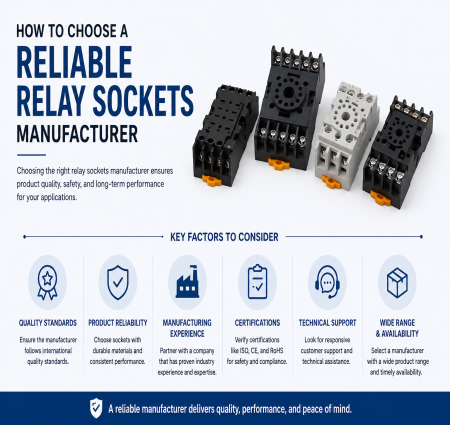

Trusted Electrical & Electronic Components Manufacturer In India
Verified Author Expert@DigitalDiaryWefru