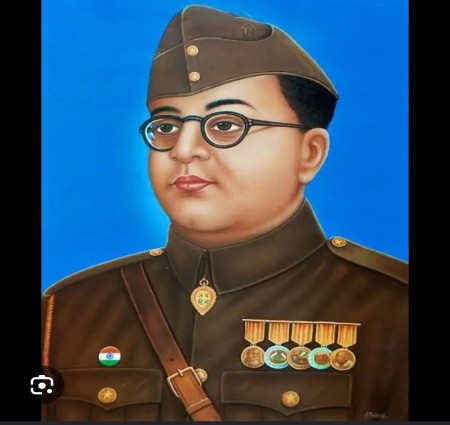
Subhash Chandra Bose
꧁ Digital Diary ༒ Wefru – India's Largest Writing Community ༒ Read, Write & Grow ༒꧂

꧁ Digital Diary ༒ Wefru – India's Largest Writing Community ༒ Read, Write & Grow ༒꧂
Scan QR code to visit our website

Subhash Chandra Bose (1897–1945) was a paramount leader in India's struggle for independence. Popularly known as Netaji, he advocated for armed resistance against British rule. His fiery patriotism and creation of the Indian National Army (INA) continue to inspire millions.Early Life and EducationSubhash Chandra Bose was born on January 23, 1897, in Cuttack, Odisha, to an affluent family. A brilliant student, he graduated from Presidency College in Kolkata and later traveled to England to study at the University of Cambridge. He successfully passed the rigorous Indian Civil Service (ICS) examination but resigned shortly after in 1921. Returning to India, he chose to dedicate his life to the anti-colonial nationalist movement, profoundly influenced by the spiritual teachings of Swami Vivekananda and the political ideologies of Chittaranjan Das.Political Career and IdeologyBose joined the Indian National Congress (INC) and quickly rose to prominence. He was elected as the Congress President twice-in 1938 and 1939. However, his belief in utilizing force and immediate action to oust the British clashed with Mahatma Gandhi's philosophy of non-violence. Consequently, Bose resigned from the Congress and formed the Forward Bloc in 1939 to consolidate radical and left-wing political forces.The Indian National Army (INA)During World War II, Bose made a daring escape from British house arrest in Kolkata in 1941. Believing that "an enemy's enemy is a friend," he sought military assistance from Axis powers like Germany and Japan to liberate India. In 1943, he traveled to Southeast Asia and took command of the Indian National Army (INA), also known as the Azad Hind Fauj. The INA was largely composed of Indian prisoners of war and expatriates.Netaji galvanized these troops with his famous rallying cry, "Give me blood, and I shall give you freedom!" Under his leadership, the INA marched towards the Indian borders, fighting valiantly alongside the Japanese army. It was under his command on July 6, 1944, that he famously referred to Mahatma Gandhi as the 'Father of the Nation' during a broadcast on Azad Hind Radio.LegacyThe military campaign of the INA eventually faltered due to changing dynamics at the end of World War II. Bose's life came to a tragic and mysterious end on August 18, 1945, following a reported plane crash in Taiwan. Although his life was cut short, his impact on India's freedom struggle was immense. The trials of INA soldiers following the war triggered widespread unrest in India, accelerating the British decision to finally grant independence. Today, his birth anniversary is celebrated as Parakram Diwas in India to honor his unparalleled courage and dedication.
Verified Brand
Avul pakir jainulabdeen abdul kalam born on 15th October 1931 was an aerospace scientist who served and tha 11th president of India from 2002 to 2007 he spent nearly 14 years as a scientist and science administrator mainly at the difference research and development organisation (DRDO) and India space research organisation (ISRO) . He was known Ada missile man of India for his work on the deployment of ballistic missile and lunch vehicle technology. After leaving office Kalam become a visiting professor at shillong, IIM Ahmedabad and IIM Indore. Kalam dead on 27th July 2015 in Shillong following a cardiac arrest
Have a question about this post? Send it straight to the author — only they will see it.
We are accepting Guest Posting on our website for all categories.


Digital.blog.mehak
Verified Author Expert@DigitalDiaryWefru