Isaac Newton
꧁ Digital Diary ༒ Wefru – India's Largest Writing Community ༒ Read, Write & Grow ༒꧂

꧁ Digital Diary ༒ Wefru – India's Largest Writing Community ༒ Read, Write & Grow ༒꧂
Scan QR code to visit our website

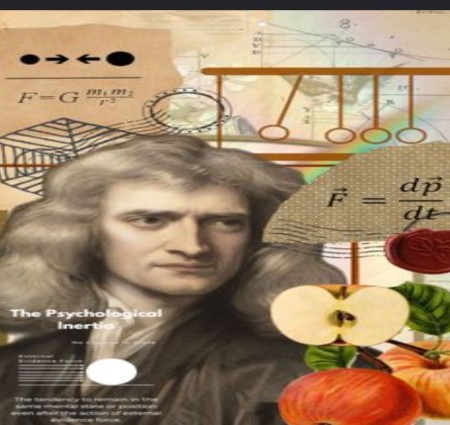
Sir Isaac Newton (1642–1727) was an English polymath who revolutionized physics, mathematics, and astronomy. He formulated the laws of universal gravitation and motion, co-developed calculus, and explained the composition of light. His foundational work laid the cornerstone for modern classical mechanics and the Scientific Revolution.IntroductionSir Isaac Newton stands as one of the most brilliant and influential figures in the history of human civilization. Born on December 25, 1642 (January 4, 1643, by the modern calendar) in Woolsthorpe, England, Newton was a physicist, mathematician, astronomer, and theologian. His groundbreaking work bridged the gap between the Scientific Revolution and the modern age. Through his rigorous application of mathematics to the physical world, Newton transformed how humanity understands the universe.Early Life and EducationNewton's early life was marked by hardship and quiet curiosity. His father, a farmer, passed away three months before he was born, and he was largely raised by his grandmother. He attended The King's School in Grantham, where he developed a deep fascination with mechanics and books. He later enrolled at Trinity College, Cambridge, in 1661. It was during the plague years of 1665–1666-when the university closed and Newton returned home-that he experienced a period of unparalleled intellectual discovery, laying the groundwork for many of his most famous theories.Major Scientific ContributionsNewton's accomplishments span multiple disciplines, with his three most significant areas of contribution being mechanics, optics, and mathematics:Laws of Motion: Newton formulated the three fundamental laws of motion-inertia, the relationship between force and mass, and action-reaction. These principles became the absolute bedrock of classical mechanics.Law of Universal Gravitation: Popularized by the legendary story of an apple falling from a tree, Newton proposed that every object in the universe attracts every other object with a force dependent on mass and distance. This unified the physics of the heavens and the earth, explaining the orbits of planets.Optics: Newton demonstrated through his experiments with prisms that white light is not pure, but rather a spectrum of all the visible colors. He also invented the reflecting telescope to reduce chromatic aberration in astronomical observations.Mathematics: Alongside Gottfried Wilhelm Leibniz, Newton developed calculus. This mathematical framework remains essential for modern science, engineering, and advanced physics.Legacy and Later LifeIn 1687, Newton published his masterpiece, Philosophiæ Naturalis Principia Mathematica. It is widely considered one of the most important scientific books ever written. Later in life, Newton transitioned into public service, becoming the Warden and Master of the Royal Mint. He also served as the President of the Royal Society and was the first scientist to be knighted. He died in 1727 and was buried with great honors in Westminster Abbey.ConclusionSir Isaac Newton's work did not just answer immediate scientific questions; it established a rigorous, mathematically driven method of investigating the natural world. His theories allowed humanity to predict the movement of stars, invent new machines, and lay the foundations for the Industrial Revolution. More than an inventor of formulas, Newton was an architect of modern science whose discoveries shape our daily lives even today.
Verified Brand
Avul pakir jainulabdeen abdul kalam born on 15th October 1931 was an aerospace scientist who served and tha 11th president of India from 2002 to 2007 he spent nearly 14 years as a scientist and science administrator mainly at the difference research and development organisation (DRDO) and India space research organisation (ISRO) . He was known Ada missile man of India for his work on the deployment of ballistic missile and lunch vehicle technology. After leaving office Kalam become a visiting professor at shillong, IIM Ahmedabad and IIM Indore. Kalam dead on 27th July 2015 in Shillong following a cardiac arrest
Have a question about this post? Send it straight to the author — only they will see it.
We are accepting Guest Posting on our website for all categories.

Digital.blog.mehak
Verified Author Expert@DigitalDiaryWefru